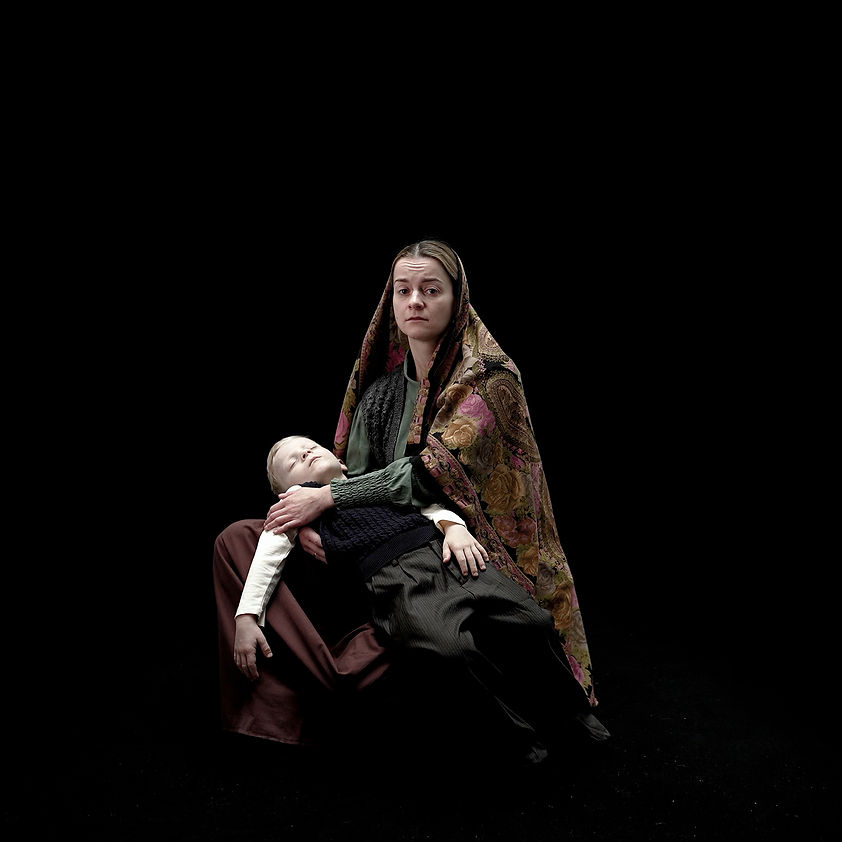
MATKA
2026
videoprojection 5,55 loop
1:1 to human size
Acting: Katarzyna and Philip Wiktorko
Art of Remembrance brings together contemporary artworks created through residencies at World War II remembrance sites across Europe. The artists were invited to spend time in places shaped by the war, working with archives, landscapes, historians, and local communities to create new works grounded in direct encounter rather than distant interpretation. The exhibition approaches memory as something fragile and ongoing, shaped not only by monuments and official narratives, but also by material traces, everyday gestures, and forms of care and survival that persist across generations. Trees marked by explosions, underground structures reclaimed by nature, diaries, songs, domestic objects, and bodily presence form a shared vocabulary through which the past is revisited and re-experienced.
The title MATKA by Juhana Moisander carries a double meaning: in Polish, matka means “mother,” while in Finnish it signifies “journey.” Moisander encountered this linguistic coincidence in archival testimony, where a deportee described the rhythm of a departing train as repeating mat-ka. The word thus becomes a conceptual hinge linking maternal presence, forced travel, separation, and loss. Rather than presenting historical events directly, MATKA approaches the aftermath of war through metaphor, repetition, and affect. Instead of reproducing the religious motif of the Pietà, the work uses it as a visual entry point embedded in Polish cultural memory: a mother and child appear at human scale within a darkened, enclosed space, inviting an intimate encounter. Their stillness, punctuated by subtle movement, evokes care, vulnerability, and suspended time. Sound forms a central layer of the installation. Drawing on children’s songs and lullabies as carriers of collective memory, the soundscape references a Polish lullaby whose calm surface conceals unsettling turns, allowing gentle forms to hold rupture and loss. Through this interplay of image, sound, and spatial containment, MATKA reflects on how trauma persists in bodies, rhythms, and language, proposing remembrance as a shared and fragile space shaped as much by care and presence as by absence.
Spark´s tale
From the ashpan, toward Wojtuś,
A little spark is blinking,
;Come, I’ll tell you a fairy tale,
The tale will be long.;
Once there was a princess,
She fell in love with a minstrel,
The king threw them a wedding feast—
And that’s the end of the tale...
There once was Baba Yaga,
She had a candy cottage,
And inside that little house,
Strange things—hush, the spark went out.
Wojtuś looks, he looks, he thinks,
His little eyes are teary,
“Why did you tell me a lie?
Wojtuś will remember.”
“I’ll never believe you again,
Little spark so small,
You shine a moment, then go dark—
And that’s the whole tale.”
There once was a king, there was a page,
There was a princess too,
They lived on seas, they knew no storms—
It’s absolutely true.
The king was in love, the page was in love,
They both loved the princess,
And she loved them both as well—
They all loved each other.
But then one day something happened,
Terrible beyond words:
A dog ate the king, a cat ate the page,
And a mouse ate the princess.
But don’t be sad, beloved child,
Don’t let this story grieve you—
The king was made of sugar sweet,
The page of gingerbread,
And the princess, marzipan.